The Cedi’s Depreciation Is More Complicated Than I Thought
September 1, 2026•13 min read
Last updated October 14, 2026
For most of my life, when the cedi depreciated, I did what most Ghanaians always do.
I blamed the president. Whoever was in office at the time got the blame. It felt like the right thing to do. The cedi is getting weaker, so it means the government is doing a bad job.
This was my thinking all my years growing up. But not anymore.
I've been hearing about terms like the “central bank”, “exchange rates”, and “inflation” since I was a kid. It was always background noise. I would watch TV and the news anchor would say the cedi had depreciated again. People would then go on Twitter and blame whoever was in power. Then everyone would move on with their day.
I never really stopped to ask myself what was actually happening. Why did the cedi depreciate again? What was actually going on behind the scenes? Does the government just want its people to continue to suffer?
Recently, I watched a video on YouTube by Shaunn Armah titled Accra's traffic problem explained. A part of that video did a really good job at pointing out a lot of inconsistencies in the government's efforts to curb traffic in Accra, and it weirdly got me thinking about how quick we are to blame the government for things without really understanding what's going on behind the scenes.
This is what inspired me to start reading about how the economy works, and what actually happens behind the scenes that causes the cedi to depreciate so frequently.
What I found really surprised me.
The government definitely plays a role in why the cedi depreciates. But the real cause behind the cedi's depreciation is much bigger than whoever happens to be sitting in Jubilee House.
It all starts with what we buy and sell
Think about the things you spend money on every day.
You buy fuel at the filling station. You buy a phone made outside Ghana. You might buy a car that was imported. Most of the medicine in pharmacies across the country comes from abroad. Many Ghanaian businesses also import things like machines, spare parts, electronics and all kinds of other things.
The thing is, when a business or a person buys products from another country, they need foreign currency to make that purchase.
If you want to buy something from a company in China, the company isn't going to say, "Sure, send us some Ghana cedis." They want dollars, yuan, euros or another currency they can use.
So somewhere along the way, your cedis have to be exchanged for foreign currency.
Now look at the other side.
Ghana sells things to the rest of the world too. We sell gold, cocoa, oil and other goods and services. Foreign buyers pay for those things with foreign currencies like dollars, pounds, etc.
That's one of the major ways foreign currency enters the country.
So there is a constant flow: Foreign currency comes in when Ghana sells to the outside world, and it goes out when Ghana buys from the outside world.
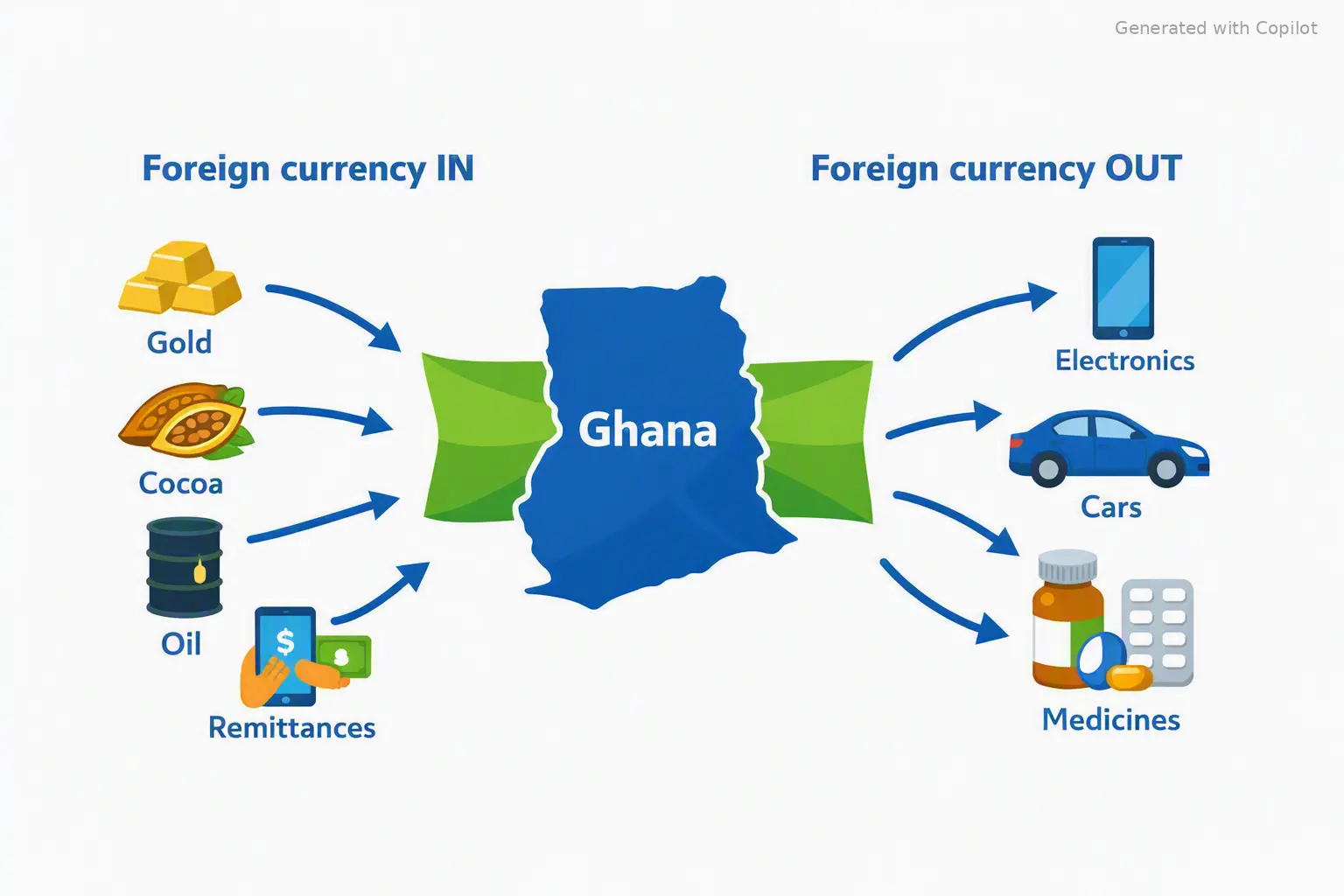
This is where things start to get interesting: because it is this flow of money in and out of the country that determines how much a dollar actually costs.
So who decides how much a dollar costs?
You will sometimes hear people say things like, "A dollar is now GH₵12."
But who decided that?
Did someone at the Bank of Ghana wake up one morning and say, "Today, one dollar will be GH₵12"?
Not really.
Ghana has a managed floating exchange rate. This means that the value of the cedi against other currencies is largely determined by ordinary buying and selling, though the Bank of Ghana does sometimes step in to calm things down.
Think about a forex bureau.
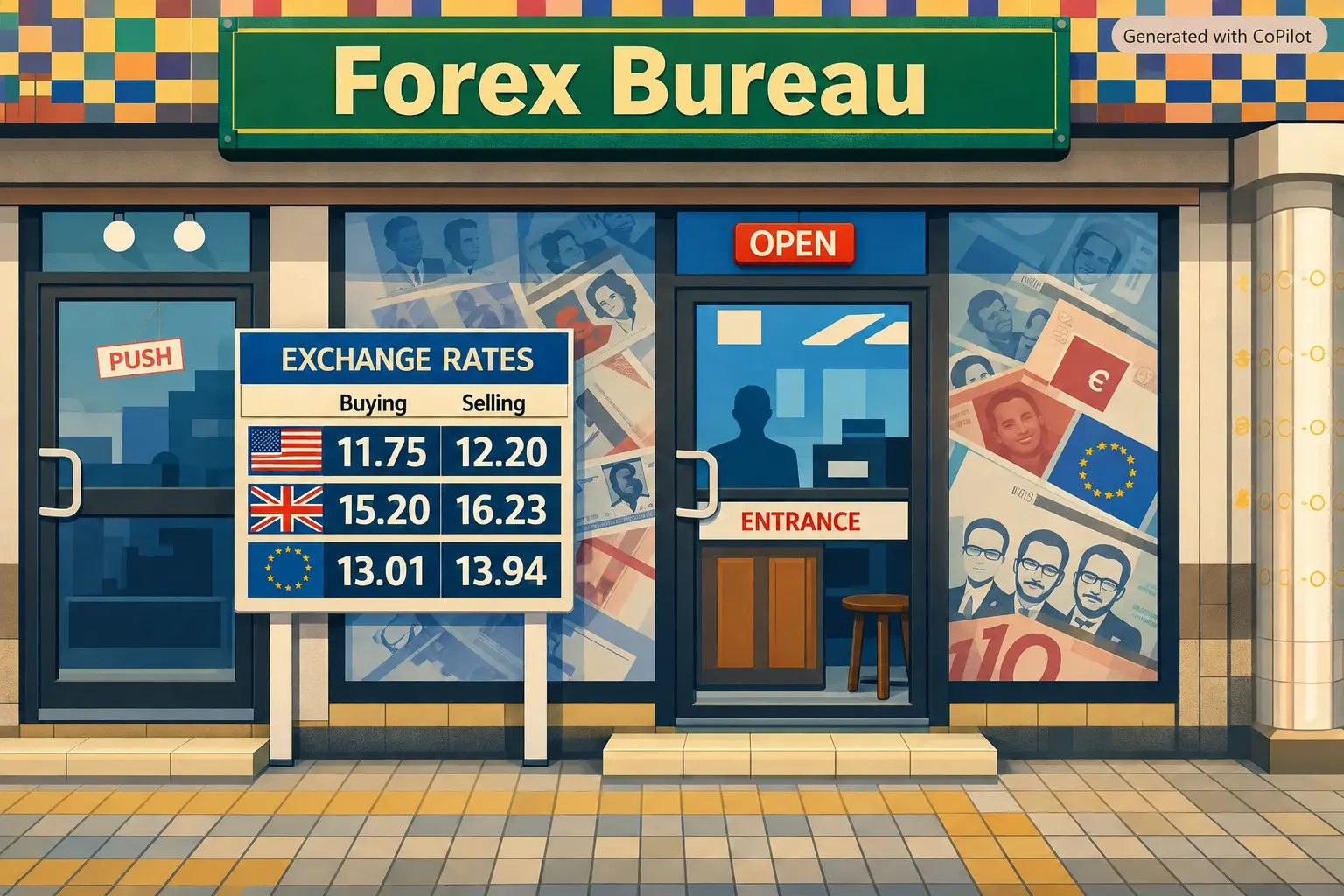
You walk into a forex bureau with 500 cedis and want to exchange for dollars. Someone else may be coming in with 100 dollars and want to exchange for cedis. Banks and big businesses do the same thing on a much bigger scale.
A bank might need a million dollars for a company that's trying to import rice into the country. Also, a shop owner that's trying to import phones might need dollars to pay for her products. All of them are competing for foreign currency.
Now imagine several of these businesses need dollars at the same time.
At this point, the banks, forex bureaus and big companies who normally sell dollars start to hold back on selling. They can sense the demand for dollars rising, so instead of selling their dollars at the normal price, they wait for the price to go higher before selling.
So that means there will be fewer dollars on the market that you can actually buy at the normal price, and when that happens, the price of dollars starts going up.
It's not very different from what happens at Kejetia when something becomes scarce, and there is high demand for it.
If there are 100 bags of Cindy Rice left on the market, and 1,000 people are trying to buy them, the sellers have the upper hand and can charge higher prices if they want to.
Foreign currency works in a similar way.
When dollars are relatively scarce and demand for them is high, their price rises. That's how you can go from GH₵10 for a dollar to GH₵12.
And that price change from GH₵10 to GH₵12 actually affects everything you buy from abroad.
Someone might be selling a laptop abroad for $500. When the rate is GH₵10 for a dollar, you need GH₵5,000. When the rate becomes GH₵12, you need GH₵6,000 for the same laptop.
The laptop's price didn't change. The Cedi just simply became weaker against the dollar.
Many businessmen save their money at the bank in cedis, money they'll eventually use to buy machines, spare parts, or other things from abroad. When the cedi depreciates, that same amount of money buys less from abroad.
Imagine you run a business and have GH₵500,000 sitting in your bank account.
You could keep everything in cedis and continue losing the value of your money as the cedi depreciates, or you would convert some of it into dollars so that your money does not lose value, no matter what happens to the cedi.
It's not just business owners who think this way. Big companies, banks and investors do the same thing. When they see the Cedi is about to depreciate, they move some of their money into dollars.
And when a lot of people and businesses do this at the same time, it creates even more demand for dollars and the price starts going up.
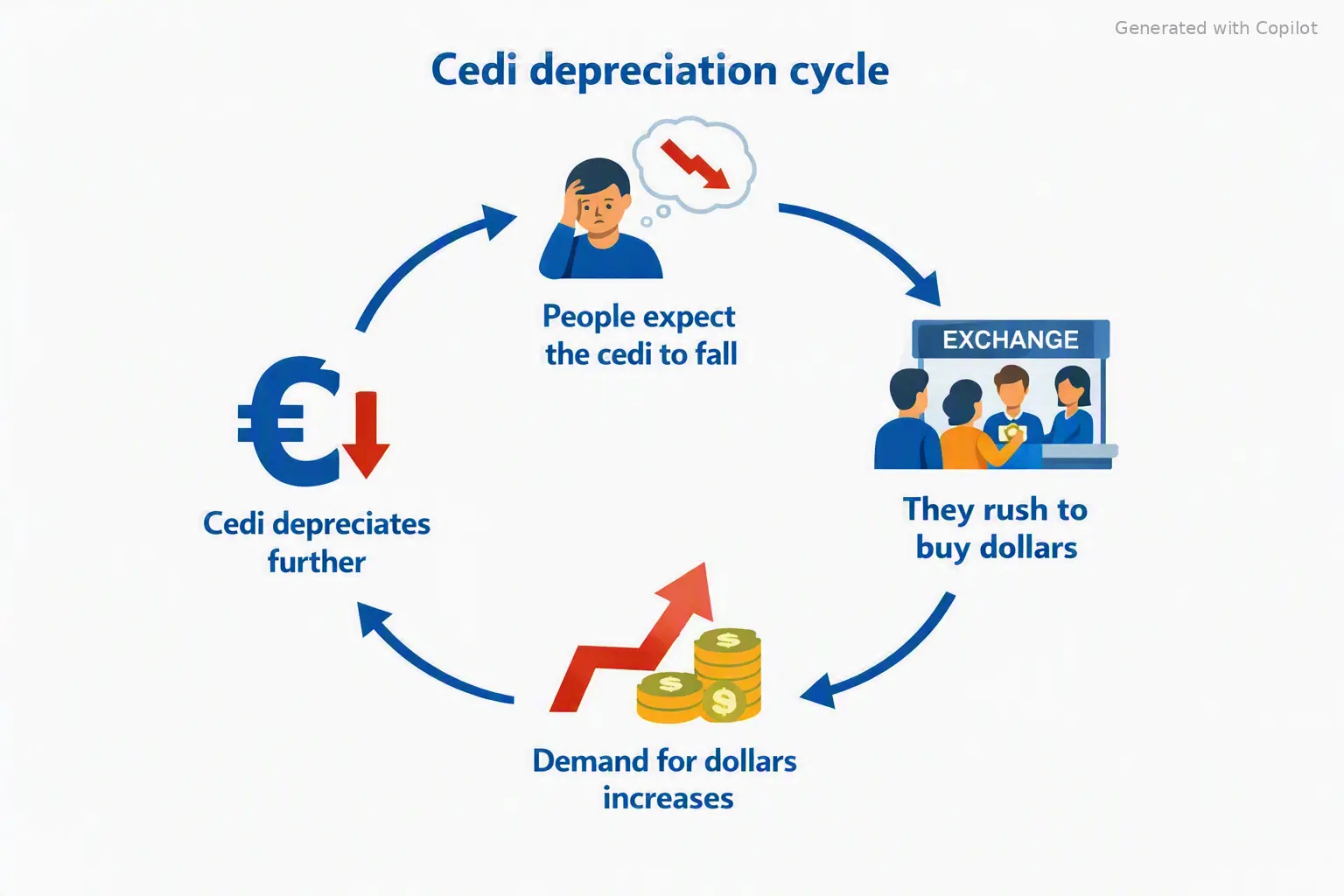
It's a bit like hearing that fuel prices are about to go up and rushing to the filling station to buy fuel before the increase.
If everyone does it at the same time, the rush itself will make the fuel available in the country become very low. And that can end up pushing the fuel price even higher than it was initially expected to go.
A few businesses or people buying dollars to protect the value of their money can make perfect sense. But when thousands of people and businesses do it at the same time, it becomes a problem for the entire economy.
Where does Ghana get dollars?
The Bank of Ghana can print cedis, but it can't simply print US dollars. So where do the dollars in the country come from?
As I mentioned earlier, selling or exporting products abroad is one of the major ways dollars get into the system. When Ghana sells things like gold, cocoa, oil, etc. to buyers abroad, we receive foreign currency as payment.
Ghana also receives foreign currency via sources like money sent home by Ghanaians living abroad, loans we receive from other countries, among others.
But the thing is, when we receive foreign currency, we don't spend all of it immediately. The Bank of Ghana keeps some of it aside and saves it up for emergency use. That saved-up foreign currency is called a reserve.
Think of a reserve as an emergency savings account for the country.
If you have GH₵10,000 saved and your car suddenly breaks down, you can use that money to cover the expense. But if you have nothing saved, the emergency can leave you stranded.
Countries are not that different.
When the cedi comes under pressure and dollars become scarce, the Bank of Ghana can use some of its foreign-currency reserves to supply dollars to the market.
This gives it some ability to reduce pressure on the cedi.
But when those reserves are running low, the Bank of Ghana will simply have fewer dollars available to protect the cedi.
And reserves can run low for reasons that have nothing to do with Ghana itself.
If the price of cocoa falls sharply on the world market, Ghana earns less from cocoa exports. If oil prices fall, oil revenues are affected too. Less foreign currency coming in means less the Bank of Ghana can set aside as reserves.
So it's clear that reserves can run out. But running out of foreign currency isn't even the biggest problem the Bank of Ghana faces.
There's a limit to what the Bank of Ghana can do
When the cedi is under serious pressure, one of the Bank of Ghana's options is to sell some of its foreign-currency reserves.
The idea is simple: make more dollars available, reduce the shortage, and this will ease some of the pressure on the cedi.
But there's a limit.
Imagine you have GH₵10,000 in your savings account and you're spending GH₵1,000 every week trying to solve a problem that will not go away anytime soon. Eventually, the money will run out.
The Bank of Ghana faces the same problem with foreign reserves. It cannot keep selling dollars forever.
There's also another limit. The Bank of Ghana can't simply announce, "From tomorrow, the dollar is GH₵8," and expect everyone to obey.
If dollars are scarce, people and businesses won't necessarily sell them at a price lower than what they believe those dollars are worth.
You can therefore end up with a situation where the official exchange rate says one thing, while people are actually buying and selling dollars at a higher rate elsewhere.
If the official rate says GH₵12 to a dollar but nobody is willing to sell you dollars at that price, the official rate doesn't help you much. You'll still have to pay the price the market is actually demanding at that moment.
So the central bank is always balancing two things:
- How much should it step in to support the cedi?
- How much of its reserves can it afford to use?
All this shows that the Bank of Ghana can definitely slow down the cedi's depreciation, but it can't stop it entirely. And to understand this further, you have to set the central bank aside and look at the kind of economy Ghana actually has.
The problem the Bank of Ghana cannot fix
The real issue isn't simply how many dollars the central bank is willing to put into the system. It's how Ghana earns foreign currency in the first place.
Think about what Ghana buys from other countries: phones, laptops, cars, medicine, machines, spare parts, almost everything.
Now think about what we sell to earn foreign currency in return. It comes down to a small handful of things, mainly gold and cocoa.
That's a problem.
Every time Ghanaian businesses and everyday people buy something from abroad, foreign currency leaves the country. But much of the foreign currency coming back depends on how much the world is willing to pay for our major exports.
So if gold or cocoa prices fall, or if we produce less of them, fewer foreign currencies come in. But the thing is, people don't stop importing goods from abroad just because gold or cocoa are having a bad year. Imports continue, so foreign currency keeps leaving the country.
On top of that, we mostly sell raw gold and raw cocoa instead of turning them into finished goods like chocolate and jewellery, which cost more money. So we earn less money from our exports even when gold and cocoa prices are good on the world market.
As long as Ghana imports most of what it consumes and exports mainly raw materials, the cedi will continue to be exposed to ups and downs, no matter how well the Bank of Ghana does its job.
That's why the real fix isn't something the Bank of Ghana can do on its own.
It has to come from changing the economy itself: producing more of what we consume and turning more of our raw materials into finished goods before exporting them.
This could mean processing more of our own gold instead of exporting it raw and buying back expensive jewellery, electronics, or machinery made outside the country.
It also could mean tourism, technology, manufacturing, or farming more of what we currently import.
Until that happens, the cedi will remain vulnerable, no matter who's in charge.
Closing thoughts
Now that I understand all this, one thing that bothers me is how rarely any of it gets explained to ordinary Ghanaians in a way they can actually understand.
It's easy to say, "The dollar has gone up because of global conditions." It's easy for one political party to blame the other, and also easy to say the previous government caused the problem or the current one is making it worse.
The thing is, none of that explains the whole picture.
The cedi's depreciation is influenced by many things:
- How much Ghana earns from exports
- How many products we import
- What the Bank of Ghana can accomplish with its foreign reserves
- What's happening to gold, cocoa and oil prices around the world.
- How businesses, investors and ordinary people respond when they see the cedi is about to depreciate
These factors all affect one another.
So the cedi's problem is never simply about who is the president. A lot of things are connected to each other, and all of them affect the cedi.
So if we want things to really get better, changing the person at the top is not enough.